A small puddle after a Dublin downpour can look alarming. Sometimes it is a short-lived drainage issue; other times it points to a low spot, a blocked outlet or damaged materials beneath the waterproofing.
The key question isn’t whether water is sitting on the roof, but why it is there and what else is happening around it.
Key Takeaways
- A puddle is a symptom, not an automatic diagnosis of a leaking roof.
- Depth, location, recurrence and associated damage matter more than a fixed drying-time rule.
- Drainage, waterproofing and the roof deck must be assessed separately.
- Stay off the roof; wet surfaces and concealed weak areas make investigation dangerous.
What Does Ponding Water on a Flat Roof Mean?
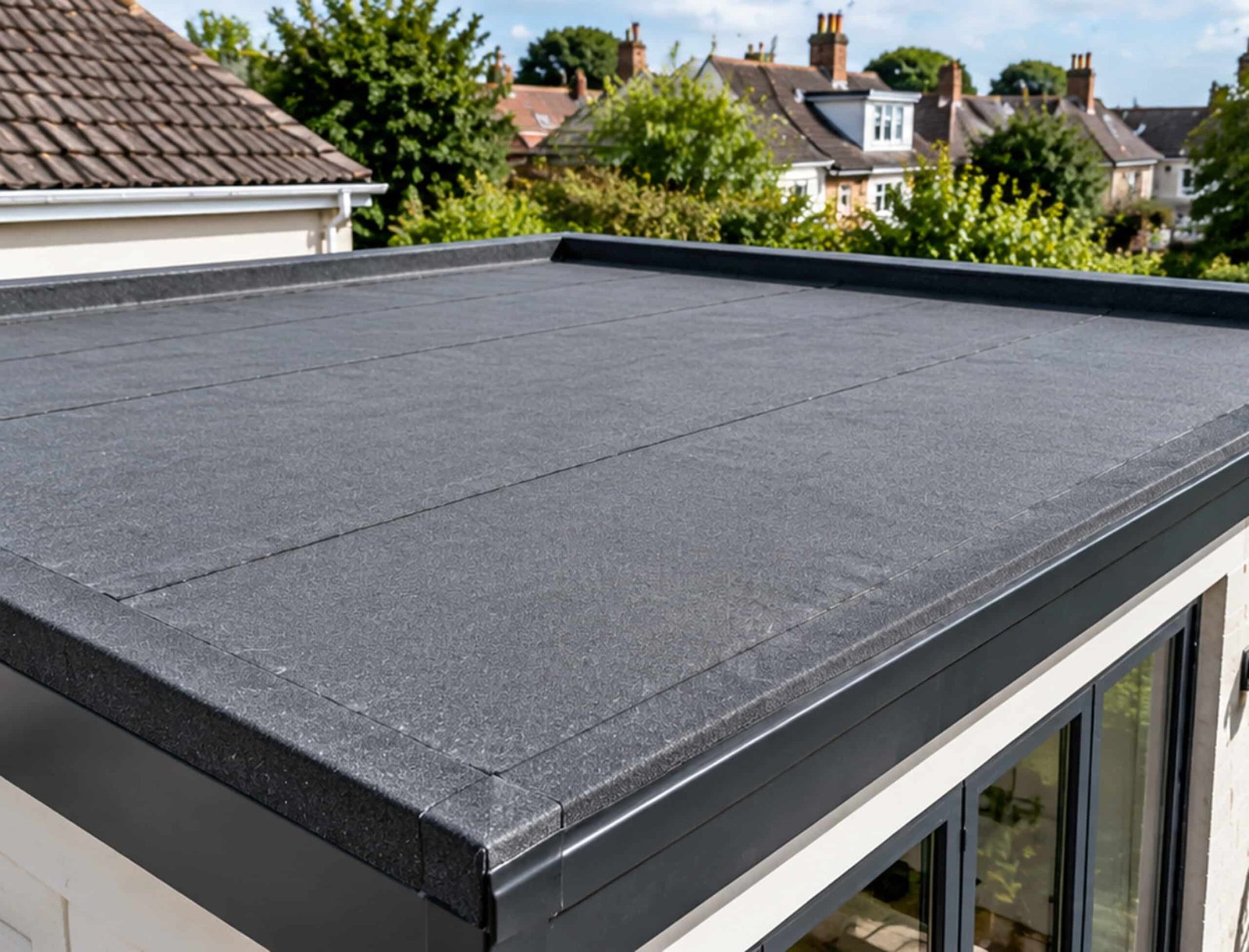
A flat roof is not perfectly level. It normally has a subtle fall that guides rainwater towards an outlet, gutter or drain. Ponding happens when water collects in a low spot instead of moving away freely.
It may appear as a shallow film close to an outlet, a wide puddle in the centre of an extension roof, or a deeper pool held against a parapet. Those patterns do not carry the same risk.
A little water immediately after heavy rain is not, by itself, proof that your flat roof is failing. More useful questions are where it collects, how much collects, how long the surface stays wet compared with nearby areas, and whether the problem has changed over time.
A waterproof roof is meant to resist rain, but persistent standing water may reveal poor drainage, movement in the roof build-up, or details that need attention.
If a puddle returns in exactly the same place after most storms, photograph it from a safe indoor or ground-level position. Repeated evidence is more valuable than guessing at the cause during one unusually wet day.
When Is Standing Water a Genuine Problem?
Start with the roof’s behaviour, not a stopwatch. A broad pond that reaches door thresholds, sits against an ageing seam, or gets progressively deeper deserves attention. So does water gathering around a blocked outlet, especially on a roof enclosed by parapet walls.
Seek a professional inspection sooner when standing water appears alongside an active ceiling leak, damp insulation, visible membrane splits, movement underfoot, a sagging deck or an outlet that no longer carries runoff. Water weight also matters: every 10 mm of standing water adds roughly 10 kg per square metre of load. That does not mean any 10 mm puddle creates structural danger; it illustrates why extensive or deep accumulation should not be dismissed when a roof is already deflecting. A competent professional should assess structural questions rather than inferring safety from appearance alone.
Some roofing materials and systems tolerate temporary water exposure better than others. The suitability of a roof with standing water depends on the membrane, its seams, terminations, warranty conditions, roof slope and supporting structure. Avoid universal statements that all EPDM, GRP or felt roofs tolerate the same depth or duration.
Seven Reasons Water Pools on Flat Roofs
- Insufficient Falls. Some roofs were constructed with too little slope, while others have lost effective falls after settlement. An installer needs to assess the finished roof rather than assuming the original design is still performing.
- A Restricted Outlet. An outlet blocked by leaves, debris or displaced material can hold back water. A roof drainage inspection should identify the obstruction and its cause; blocked drains should not automatically be diagnosed as failed waterproofing.
- Settlement or Deflection. Decking or supporting timbers can sag between joists, creating a basin. If a depression is new or soft under pressure, the structure and decking deserve closer assessment.
- Poorly Positioned Outlets. A roof outlet may be higher than an adjacent low spot or lack a recessed sump, leaving a permanent ring of water.
- Changes to the Roof Build-Up. Added insulation, overlaid membranes or poorly integrated patches can create raised edges and trap runoff. The patch may be watertight yet worsen drainage.
- Complex Junctions. Rooflights, parapets, kerbs and plant bases interrupt water flow. A low spot behind an upstand can remain wet long after the open field dries.
- Unexpected Runoff. A higher roof discharging onto a smaller extension, or a downpipe diverting water across the surface, may overload a drainage arrangement that once worked adequately. A roofing inspection should trace where the water arrives, not simply where it settles.
How Long Is Too Long for a Puddle to Remain?
You may encounter claims that every puddle must disappear within 24, 48 or 72 hours. Those timeframes are sometimes used in product or inspection discussions, but they are not a universal pass-or-fail rule for every roof in Dublin.
Evaporation depends on temperature, wind, sun, rainfall frequency, surface shading and the depth of the depression. A shaded extension after several wet autumn days may dry much more slowly than the same roof in July.
Record the puddle’s size and position after rainfall, then check it again from the same vantage point when it’s safe. If nearby sections dry while one pocket remains filled, that pattern helps identify a local depression.
If every rainfall leaves new or expanding ponds, the drainage geometry may have changed. If water stands close to a door, a parapet, an outlet or a damaged membrane, the location deserves as much attention as the time elapsed.
When assessing a replacement or major refurbishment, designers should consider appropriate falls, outlet capacity and overflow provision for the selected system. Roof standards and manufacturer details govern that design; they should not be replaced with an arbitrary homeowner rule.
Why Roof Falls and Outlets Matter More Than Roof Appearance
A roof can look almost level from an upstairs window and still drain correctly. Conversely, it can visibly slope yet contain a hollow near the outlet. Flat-roof drainage is governed by the finished surface, not the angle someone thinks they can see.
Design guidance commonly distinguishes the fall allowed for in construction from the fall achieved after tolerances and deflection. For example, industry details often refer to a finished fall of about 1:80 in conventional flat-roof applications, with a steeper design fall to allow for construction tolerances. A specification must fit the roof design and applicable guidance.
Roofs surrounded by parapet walls require particular care. If the main outlet blocks, water may have nowhere obvious to escape. Overflow arrangements and outlet accessibility should be considered when designing or upgrading such roofs. Ireland’s Technical Guidance Document H addresses drainage requirements, while roof-specific system design must be handled by suitable professionals.
For wider drainage principles, see the Irish government’s Technical Guidance Document H on drainage and the NHBC’s roof-drainage detailing guidance for useful design context.
The NHBC technical guidance on flat-roof and balcony drainage also discusses finished falls, outlets and overflows; project specifications must be assessed individually.
Can Ponding Cause a Flat Roof to Leak?
Ponding does not necessarily mean a leak. Water entry still needs a route through a failed lap, puncture, edge, outlet joint, flashing or another discontinuity. Yet standing water keeps vulnerable details wet longer. A defect that sheds ordinary rainfall may allow water through when submerged for prolonged periods.
Leaks can also appear far from the puddle. Once water finds a gap in the waterproofing, it may travel across decking, insulation interfaces or structural members before showing up on the ceiling. A stain beneath one corner of a room is not reliable proof that the puncture is directly above it.
Equally, internal moisture may be caused by condensation rather than external rainfall. Warm, moist air entering a cold roof build-up can produce dampness even when the membrane remains intact. Roof ventilation and insulation design matter, particularly in older extensions or roofs that have been upgraded piecemeal.
For the distinction between roof moisture and condensation, consult SEAI’s guidance on moisture and roof construction.
Different Roof Coverings and Their Ponding Risks
Torch-on felt and bituminous systems: Standing water can highlight poor falls, aged seams, blistering or defects around outlets. A properly specified system may tolerate incidental ponding, but inspect patches and laps when deterioration appears.
EPDM rubber membranes: EPDM is used because it forms a durable waterproof surface, often with fewer field seams. That does not make every roof immune to water at adhesive joints, perimeter details or outlets. Compatibility, attachment and manufacturer requirements still matter.
GRP fibreglass roofs: A continuous-looking GRP surface can hold water if falls are inadequate. Repeated thermal movement, cracking around details or construction defects may matter more than the puddle alone.
Liquid-applied and other single-ply systems: Performance depends on application thickness, substrate preparation, joints, upstands and product certification. An apparent ponding problem must be assessed against the actual specification, not a blanket assumption that one technology is always superior.
If wet insulation or deteriorated deck boards are suspected, recoating the surface without investigating below can hide the underlying problem.
What You Can Check Without Walking on the Roof
The safest first step is observation from inside the house, through an upper window or from the ground where the roof is visible. Do not climb onto a wet flat roof or lean over an unprotected edge. Rooflights and weakened decking can be fragile, even if the surrounding roof looks sound.
Check whether the standing water follows heavy rainfall or appears after smaller showers. Note whether the problem is local or widespread. Look for visible leaf obstruction around an outlet, but don’t reach across the roof to remove it.
Photograph any ceiling staining and note when it appears. Record whether the affected room has poor ventilation or persistent indoor condensation.
If water is entering near electrical fittings, stay clear of the affected area and seek urgent, appropriate assistance. Avoid puncturing the membrane, brushing water towards a rooflight, drilling drainage holes or applying random sealant. Those shortcuts can worsen leaks or damage the waterproofing.
The HSA Code of Practice for Safety in Roofwork explains why work near fragile coverings and unprotected edges must be properly controlled.
What a Proper Flat Roof Ponding Inspection Should Include
A good assessment starts by establishing the original construction and what has changed. The roofer should identify the waterproofing material, roof age (where known), drainage outlets, surrounding parapets, rooflights, visible repairs, and the routes water takes to the roof.
Next comes a drainage survey: locate the low point, assess falls, check outlets and determine whether water is trapped behind raised insulation, patches or kerbs. The investigation should consider the condition of seams and upstands, the integrity of the deck, the possibility of moisture within the insulation, and whether ponding is associated with ceiling dampness.
Not all of this can be done visually. A competent contractor may recommend controlled opening-up or appropriate testing when concealed damage is suspected. That step should be agreed before disruptive work starts. A written report or quotation should distinguish observed defects from assumptions and explain whether the recommendation addresses the source of pooling, the waterproofing defect, or both.
The Available Repair Options – From Local Drainage Corrections to Replacement
Correct an isolated drainage defect. When the roof covering and deck are sound, a properly designed outlet correction, sump or localised adjustment may improve drainage. The repair must remain compatible with the waterproofing and should not create another trap upstream.
Repair a membrane defect. If standing water has exposed a local puncture or failed joint, a compatible repair may restore watertightness. Repairing the hole does not necessarily remove the puddle, so the quotation should clearly state both objectives.
Re-form the falls. During refurbishment, tapered insulation or a redesigned substrate can direct water toward drainage points. This may also improve thermal performance, provided the moisture and ventilation strategy is correct.
Replace damaged decking or insulation. If the deck is soft, rotten or sagging, simply covering it again is unlikely to last. A safe repair requires identifying and replacing affected components and investigating why moisture accumulated.
Replace the roof system. A wider replacement becomes more reasonable when waterproofing fails in multiple places, drainage geometry is poor, insulation is saturated, or repairs would require repeated, substantial opening up. A roof should not be replaced solely because a shallow puddle appears after rain.
How Much Does It Cost to Fix Ponding Water?
There is no meaningful single price for “ponding repair” because the work may range from adjusting one outlet to rebuilding falls and replacing a roof system. The affected area, material compatibility, safe access, scaffold requirements, insulation condition and hidden deck damage all influence the quote.
Ask for the scope to be divided into diagnosis, drainage adjustments, membrane repairs and any necessary structural or insulation work. This makes it easier to see whether a quote addresses the root cause or just covers the visible puddle. It also makes variations easier to understand if hidden damage is discovered after stripping the membrane.
For a broader breakdown of repair scope and costs, our flat-roof repair cost guide explains why a local patch and full re-decking cannot be priced the same. See our detailed guide to the cost of fixing a flat roof in Dublin for a closer look at how repair scopes affect prices.
Five Questions to Ask Before Approving the Work
- What exactly is keeping the water there? The answer should identify a low point, obstruction, poor outlet location or other physical mechanism, not just repeat “the roof is flat.”
- Is the waterproofing defective? Ask whether the puddle is a drainage symptom, a membrane failure, or both.
- Has the deck or insulation been affected? If this is uncertain, ask how the contractor proposes to investigate and price the uncertainty.
- Will the proposed work change the falls? A new membrane over the same depression may look tidier but still leave water in the same place.
- How will the work be checked afterwards? A clear handover should describe completed repairs, outlets and drainage routes, together with any limitations or future monitoring needed.
Flat Roof Ponding FAQs
Is Standing Water on a Flat Roof Normal?
A shallow puddle immediately after rain is not automatically a defect. Repeated, deep or expanding ponds, especially near vulnerable details, warrant closer inspection.
Does Ponding Water Mean My Flat Roof Will Leak?
No. A leak needs a failure path through the waterproofing or a related detail. Ponding can expose an existing weakness, but standing water alone does not prove water is entering the building.
How Long Should Water Remain on a Flat Roof?
No universal time limit fits every roof. Depth, location, weather, drainage design and the membrane specification matter more than a fixed number of hours.
Can Water Pool Because the Gutter or Outlet Is Blocked?
Yes. A restricted outlet can retain water even on a correctly designed roof. The drainage route should be inspected before assuming the membrane or roof structure has failed.
Can Ponding Damage Roof Insulation?
Ponding cannot reach insulation through an intact waterproofing system. Where a seam, outlet or other detail leaks, moisture may enter the build-up and damage insulation or decking.
Should I Walk on a Flat Roof to Check the Puddle?
No. Wet membranes, unprotected edges, rooflights and damaged decking create serious risks. Arrange assessment by a competent roofing contractor using safe access methods.
Does EPDM Roofing Allow Standing Water?
EPDM can be used in robust waterproofing systems, but allowable conditions depend on product specifications and installation details. Standing water alone is not proof of performance or failure.
Can a Flat Roof Be Repaired Without Replacing It?
Often, yes. A sound deck and waterproofing system may need a local outlet or membrane repair. Widespread damage, wet insulation or structural movement may require larger work.
Will a New Waterproof Membrane Stop Ponding?
Not necessarily. If the depression or outlet arrangement stays unchanged, water may still collect after a new membrane is fitted. Falls and drainage need to be addressed separately.
Can Poor Insulation Cause Water to Pool on a Flat Roof?
Unevenly installed insulation boards can affect the finished falls. Saturated or compressed insulation can also contribute to depressions, but a roof inspection is needed to determine the cause.
What if Water Is Pooling Near a Parapet Wall?
Ask for inspection of outlets, overflow provisions, upstands and the roof-to-wall junction. Water can accumulate rapidly when drainage is obstructed on a parapet-enclosed roof.
When Should I Arrange a Professional Inspection?
Arrange one if a puddle is deep, recurrent, growing or accompanied by a leak, sagging, soft decking or damage around an outlet. Seek urgent help if water is entering near electrics or the structure appears unsafe.
Flat Roof Repairs in Dublin: Get the Cause Identified
Assess a flat roof as a complete system, not by a puddle alone. At Emergency Roofers Dublin, we help homeowners identify whether the problem lies with drainage, the roof covering, defective junctions or underlying damage. We aim to explain the repair scope clearly, so you understand what we’re repairing and why.
If your extension, garage or commercial flat roof is holding water after rain, contact us with your Dublin location, a description of the problem and any photographs taken safely from the ground or indoors.
We can discuss the next steps and whether a roof assessment or repair is suitable. We do not recommend walking onto the roof to investigate it yourself. Learn more about our flat-roof repair services in Dublin, or request an assessment.