Replacing damaged fascias and soffits can be a relatively modest roofline improvement or a more involved job once old timber, guttering, access and attic ventilation are considered. For a straightforward PVC replacement, many Irish homeowners will budget roughly €900 to €4,000.
A small section can cost less, while an extensive detached house with difficult access, replacement guttering and hidden timber repairs can cost more. The key question isn’t simply “How much per metre?” but “What exactly is included in the replacement?”
This guide explains typical costs, how roofline measurements work, when boards can be repaired, why quotes can vary so much, and what to check before paying a deposit. It also covers the issues that can make an apparently inexpensive job much more costly later: unsound fascia supports, poor rainwater falls, blocked ventilation and unfinished junctions.
Average PVC Fascia and Soffit Replacement Prices in Ireland
The following figures are practical 2026 planning ranges gathered from current Irish price guides and the cost scenarios discussed in this article. They are not fixed quotations. Read them alongside the scope descriptions, because a price without a list of included work is rarely useful.
- Small localised fascia or soffit section: approximately €150–€400 where access is straightforward and adjacent boards are sound.
- Terraced house, front and rear roofline: approximately €900–€1,800 for a straightforward PVC replacement.
- Typical semi-detached house: approximately €1,500–€3,000 for the main fascia and soffit work, depending on roofline length and what is included.
- Larger detached house: approximately €2,500–€4,500 or more, especially with several elevations, complex corners or high-level access.
- Per linear metre: roughly €45–€85 is a useful starting budget band for PVC fascia and soffit work; additional gutters, downpipes, extensive substrate repairs or scaffolding can increase the total installed cost.
The ranges overlap because houses do not come in standard roofline lengths. A compact property with awkward access can cost more than a longer, uncomplicated elevation. The most reliable comparison is between written quotations covering the same measured length, materials and removal work.
What Does the Price Per Metre Actually Include?
A linear metre runs along the length of an eaves edge; it is not a square metre of soffit material. A 30-metre roofline may need 30 metres of fascia, but its soffits might be 150 mm deep in one area and 400 mm deep in another. Those are different material quantities, even though the fascia run is the same length.
A useful written quote identifies whether the per-metre rate includes the fascia board, soffit, trims, corners, joint pieces, fixings, removal of old material, disposal, gutter removal/refitting, access and VAT.
It should also say what happens if the supporting timber is found to be decayed. The depth and profile of the board are relevant: a slim capping board fixed onto verified sound timber is not the same product or installation method as a load-bearing replacement fascia.
Don’t multiply a headline €50 rate by the entire perimeter of your home and assume that’s the final invoice. Gable verges may have bargeboards rather than gutter-bearing fascias, some elevations may have no soffit, and protruding bays can add corners and access time.
Worked Cost Examples for Different Roofline Jobs
Example One: A straightforward 12-metre front elevation. At an illustrative €55–€75 per linear metre, the measured fascia and soffit work would be €660–€900 before any extra access, drainage components or timber repairs that are not included in the rate. This is a calculation to help read a quote, not a contractor offer.
Example Two: A semi-detached home with 32 metres of qualifying roofline. Using the same illustrative rate, 32 × €55–€75 produces €1,760–€2,400 for the core measured work. If gutters and downpipes also need replacing, that needs a separate or clearly itemised allowance.
A quote priced at €2,900 could be better value than one priced at €2,100 if it includes safe scaffold access, full strip-out, ventilation and drainage work that the cheaper quote excludes.
Example Three: A detached home with 48 metres, multiple corners and high gables. At €55–€75 a metre, that’s €2,640–€3,600 before special access or timber repairs. Complexity, not just length, may determine the final price. These examples show how to test a quotation’s logic; the actual measured scope matters more than the house label.
What Are Fascias, Soffits and Bargeboards?
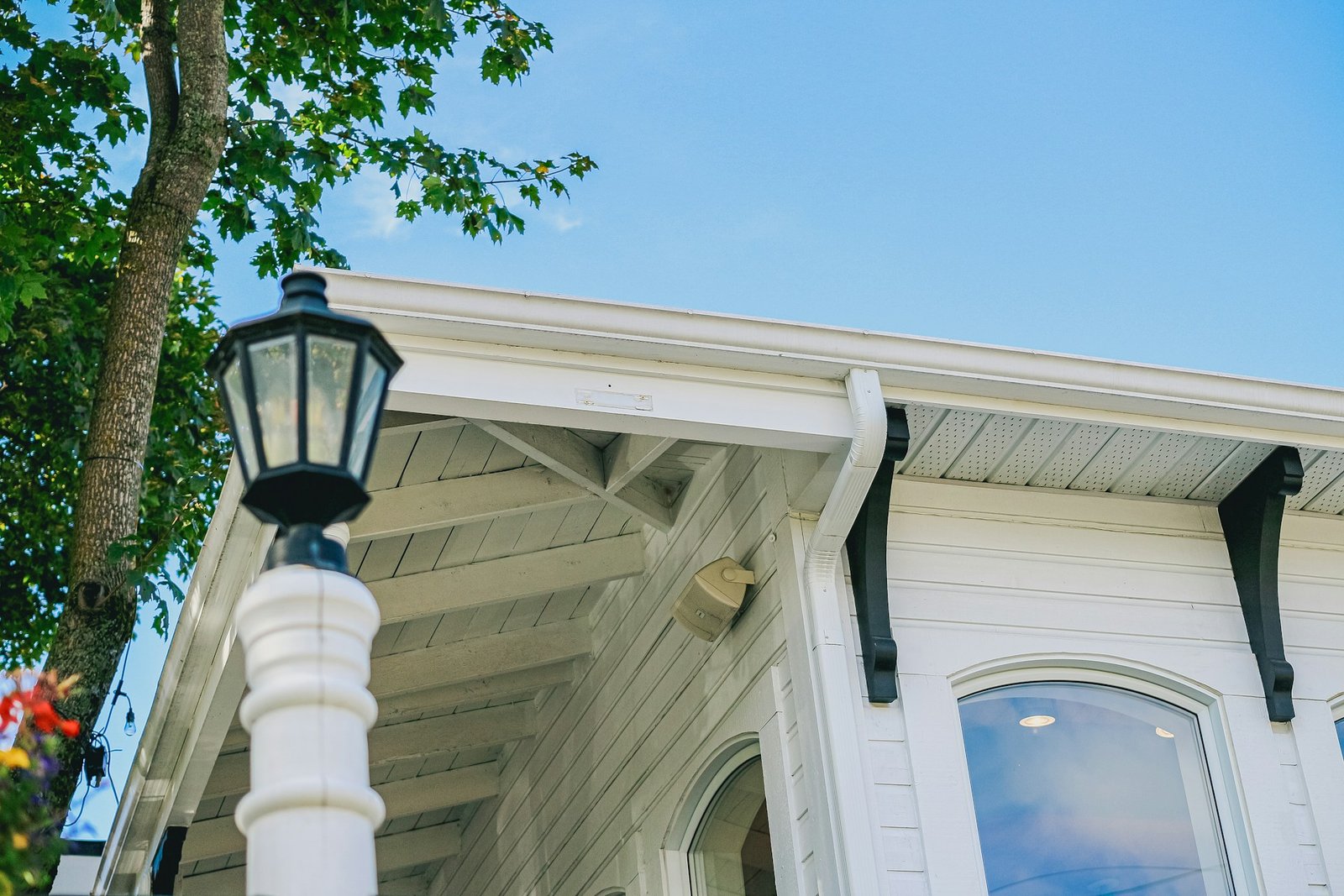
The fascia is the vertical finishing board at the roof edge, usually attached to the rafter ends or other suitable structural support. It often carries the gutter brackets and helps form a weather-resistant edge below the roof covering. Its strength matters: full gutters can impose substantial loads, so don’t assume brackets are secure just because the visible PVC looks new.
The soffit closes the underside of the overhang between the fascia and the outside wall. Some soffits provide an air path into a ventilated roof space; others are part of a different roof construction and may not require visible vents. The correct arrangement depends on the roof design and insulation details.
A bargeboard finishes the inclined edge of a gable roof. It may look similar to fascia from ground level but often differs in dimensions, fixing and junction details. Quotations should identify bargeboards separately when the property has prominent gables.
Why PVC Is Popular for Irish Rooflines
uPVC doesn’t need periodic repainting like painted timber. It offers a neat, consistent finish and comes in white, black, anthracite-style grey and woodgrain finishes. It also integrates easily into many existing domestic roofline layouts.
That does not make PVC indestructible or completely maintenance-free. Poor expansion allowances, inadequate fixing, unsuitable profiles or ageing seals can cause distortion and open joints. Dark finishes absorb more solar heat than white, so following the product’s fixing and movement requirements is particularly important. Dirt can still accumulate, and seals or adjacent gutter components may need attention.
Properly specified timber and metal alternatives can also work, especially where the building has architectural constraints, or the owner prefers a different design. The right material fits the building, exposure, intended appearance and installation detail, not necessarily the one with the lowest advertised supply price.
Seven Factors That Change the Final Replacement Cost
- First, total roofline length. Longer runs use more material and take longer to remove and replace. A short front-and-back terrace is usually simpler than a four-sided detached roofline, but only a measured site assessment confirms it.
- Second, the depth and profile of fascia and soffit. Deeper soffits, larger replacement fascias, ventilated components and shaped trims alter the material list.
- Third, underlying timber condition. Boards that look sound from the pavement can hide decayed rafter ends, damaged noggins or water-stained roof edges. Any structural repairs should be described and agreed rather than absorbed into a vague “extras” charge.
- Fourth, access. A narrow side passage, glass conservatory, sloping driveway, extension roof or adjoining property boundary can affect scaffold or work-platform arrangements. Safety cannot be priced as an optional afterthought.
- Fifth, guttering and downpipes. If sound gutters can be removed and refitted without damage and have suitable falls, their replacement may not be needed. Where the gutter profile, joints, brackets or downpipes are failing, combining the jobs can avoid repeating access costs.
- Sixth, finishes. White standard boards may be easier to source than particular colours, textures and manufacturer-specific profiles. Matching an existing extension or neighbouring elevation can require extra trims or longer lead times.
- Seventh, waste, weather and difficult junctions. Removing old boards, disposing of material, working around a chimney or extension, repairing the eaves membrane and carefully finishing corners can all affect labour.
Should You Repair or Replace Fascias and Soffits?
A single cracked board, failed joint or small wind-damaged piece may be repairable if the surrounding material and its support are still sound. A contractor should look for the cause before choosing an isolated patch.
For example, a leaking gutter can repeatedly wet the same timber area; replacing only the visible fascia leaves the cause untouched.
Replacement makes more sense when several elevations are deteriorating, fixings repeatedly pull out of rotten substrate, profiles are warped, or the existing boards cannot securely support the guttering. It can also make sense when multiple small repairs cost nearly as much as a coordinated replacement.
No universal rule says boards must be replaced after a specific number of years. Condition, installation quality, ultraviolet exposure, movement, water management and maintenance history are more useful than age alone.
Nor is it true that every timber fascia covered by PVC must be removed: the suitability of an over-cap system depends on whether the underlying board is genuinely sound, properly attached and compatible with the selected product.
Why Covering Rotten Timber With PVC Is a Bad Idea
Some roofline products are designed as capping boards over existing timber. That can be legitimate on healthy, properly supported timber when installed to the manufacturer’s requirements. It is not a repair for decay.
If the timber beneath is soft, flaking or unable to hold gutter fixings, covering it can hide a structural weakness and trap an unresolved moisture problem. The visible surface may look new while gutter brackets and roof-edge details remain compromised.
A full replacement specification should explain how the old timber is inspected and what work is included if decay is identified.
Signs worth investigating include a sagging gutter line, loose brackets, repeated staining beneath a gutter joint, peeling paint on timber, soft areas accessible for professional inspection, and damp at the upper wall or eaves.
None of these proves fascia failure on its own; roof covering, flashing, gutter joints and drainage can produce similar symptoms.
The Relationship Between Soffits and Attic Ventilation
Roof ventilation is one of the easiest parts of a replacement project to overlook. On many pitched roofs, low-level eave ventilation helps move moisture away from a cold roof space.
Blocking existing openings with new solid soffit panels or tightly compressing insulation into the eaves can change airflow and, under the wrong conditions, encourage condensation.
The correct design depends on the roof structure, underlay type, insulation arrangement and ventilation strategy.
Do not assume every roof needs the same continuous vent strip: some roofs have alternative compliant arrangements. Conversely, a house that needs eaves ventilation should not lose it because a new fascia system looks tidier without visible slots.
SEAI’s Domestic Technical Standards and Specifications emphasise maintaining appropriate eaves ventilation when insulation is installed and, where necessary, using suitable soffit vents and eaves ventilation trays.
If roofline work is being combined with attic insulation, make sure both parts of the job are designed together. See SEAI’s technical guidance for the detailed ventilation requirements.
How Guttering Affects Fascia Replacement Prices
Gutters normally sit on brackets secured to a sound fascia or another appropriate support. Replacing the fascia therefore means the installer must remove, protect and refit the gutter, or replace it with a new system.
Brackets should be positioned to support suitable falls towards the outlets while managing expansion and movement. Downpipes need clear discharge routes that do not direct water onto walls or vulnerable foundations.
When comparing quotations, ask whether the existing guttering will be reused, whether replacement seals and brackets are included, and whether the downpipes and outlets will be checked. A quote that mentions “new fascia and soffit” but doesn’t address the gutters may leave major ambiguity about both the price and the finished result.
If the drainage system itself is defective, learn how gutter repairs in Dublin can differ from a full system renewal and compare the likely scope with the separate gutter replacement cost guide.
PVC, Timber and Aluminium: Which Offers Better Value?
PVC is often the pragmatic choice for a standard home seeking a low-maintenance finish. It is light, readily available and comes in many styles. Its appearance and service life depend on the selected grade, proper fixing and joint treatment.
Timber can be attractive on period houses and can match existing architectural details. It can be repaired, shaped and repainted, but it needs the right protective finish and regular care. A properly detailed timber roofline should not be dismissed merely because it needs maintenance.
Aluminium can offer crisp profiles and a long-life finish, but the price and specification depend on thickness, coating, fabrication and corrosion considerations. Certain coastal locations or mixed-metal details call for particular attention.
Comparative prices only make sense when installation, access, rainwater components and finishing are aligned across the options.
Before choosing a material solely on cost, consider the house style, eaves design, colour preference, acceptable level of upkeep, roof exposure and any planning or conservation requirements.
Special Considerations for Older and Period Properties
Older Dublin houses can have decorative eaves, unusual timber profiles, cast-iron guttering, concealed details or neighbouring rooflines that need a sensitive approach.
An inexpensive standard PVC board may not reproduce the original profile or appearance. Historic fabric may also reveal fragile or uneven structural supports when opened.
In an architectural conservation area or on a protected structure, changing the roofline appearance or historic material may need closer consideration. A property owner should check the relevant local-authority requirements before altering important external details.
Even outside protected contexts, the objective should be a solution that manages rainwater and moisture without flattening character-defining features.
When assessing an older terrace, a quote should clearly explain how the new work matches neighbouring finishes, the arrangement of party-wall or gable junctions, and whether to retain or carefully remove original metalwork.
How Long Does Replacement Take?
A small isolated repair can be relatively quick once access is arranged. A standard house replacement commonly involves more than one work stage: setting up safe access, removing old components, assessing supporting timber, fitting boards and ventilation, installing or refitting guttering, checking drainage and clearing waste. Larger or awkward projects take longer.
Do not rely on promises of a fixed one-day or two-day turnaround for every home. Restricted access, discovered timber decay, weather and matching-material availability can change the schedule.
A useful contractor should explain what is planned, what can delay the job and how exposed roof edges will be protected if the work is interrupted.
What Should a Written Quote Include?
Ask for a clearly described scope: measured metres and elevations; fascia and soffit product type, size and colour; full replacement or capping method; gutter and downpipe treatment; condition of existing supports; ventilation details; joint, corner and gable finishing; access equipment; removal and disposal; VAT; expected start and duration; payment stages; and precisely worded guarantee coverage.
A quotation should also identify how concealed damage will be handled. A contractor cannot reasonably see every rafter end until boards are removed. Still, the process for photographs, explanation, authorisation and an agreed price for additional work should be established beforehand. The absence of that process is more worrying than an honest provisional allowance.
Ireland’s Competition and Consumer Protection Commission gives useful practical guidance on checking tradespeople, agreements and problems with home-improvement work.
Compare more than the bottom-line number. A more complete quote can save arguments later, even if it costs more overall.
Is VAT Included in Fascia and Soffit Prices?
Always ask whether a displayed price includes VAT and which treatment applies to the particular supply. Revenue lists a reduced VAT rate for many construction services, but the tax treatment of a job that includes materials and labour can depend on its structure and the two-thirds rule. Materials supplied separately can be treated differently from installed construction services.
The practical point for the homeowner is simple: compare VAT-inclusive final totals for the same work, and ask for the rate and amount to be shown on the invoice. Revenue publishes guidance on construction services and the two-thirds rule if you want to understand the distinction in more detail.
Why Safe Access Matters More Than a Cheap Quote
Roofline work is carried out at the edge of a roof, commonly above hard surfaces, extensions or entrances. There is a real fall risk even when the task sounds like a simple board swap. The safest equipment depends on height, ground conditions, reach, duration and the risks to people below.
The Health and Safety Authority says work at height should be planned, risk-assessed and performed by competent people using appropriate equipment. It prioritises avoiding falls and using collective protection where reasonably practicable.
A ladder isn’t automatically the right working platform for a full two-storey replacement, and removing necessary access protection to save a few hundred euro isn’t a real saving.
If a quote seems unusually cheap, confirm how safe access will be achieved rather than assuming all installers have allowed for the same system.
Common Installation Mistakes to Avoid
One common error is fixing new boards onto unsound supports. Another is interrupting eaves ventilation, either with unvented panels where vents were required or by pushing insulation into the air path. Poorly positioned gutter brackets can leave standing water, overflowing joints or drainage that falls the wrong way.
Other problems include insufficient allowance for PVC expansion, poorly sealed or unsupported joints, mismatched boards and trims, exposed old timber at awkward corners and unfinished connections to gable boards. These details are easiest to inspect during the work rather than after everything is closed.
A useful completion check looks at straightness, secure fixing, intact junctions, gutters flowing towards their outlets, suitable ventilation provision, removal of waste and any newly exposed roof-edge details that require attention. A contractor should explain the relevant product-care instructions and which defects are covered by written guarantees.
How to Decide Whether the Investment Is Worthwhile
Replacement is most compelling when the current system lets water reach timber, cannot support gutters, has widespread decay or needs repeated repairs. It is harder to justify on price alone if the boards are stable and only a small local defect needs fixing. A sound assessment separates problems that affect protection from purely cosmetic wear.
When comparing the short and long term, account for repeated access costs, repairs to adjacent components, gutter alignment and the risk of concealing moisture damage. Also remember that new fascia boards don’t fix every roof leak: water can enter through damaged tiles, underlay, valleys, flashings or roof-wall junctions and emerge near the fascia. Diagnosing the source is essential before assuming a decorative replacement will solve an underlying roofing problem.
Frequently Asked Questions
How Much Does PVC Fascia and Soffit Replacement Cost in Ireland?
Straightforward jobs can fall around €900–€4,000, with higher totals for larger or more complex properties. The final quote depends on scope, measured length, access, gutters and underlying repairs.
What Is the Average Cost Per Metre for PVC Fascia and Soffit Work?
Roughly €45–€85 per linear metre is a useful initial planning range for many jobs. Still, rates are not directly comparable unless materials, removal, ventilation, access, VAT and gutter work are treated consistently.
How Much Does It Cost for a Three-Bedroom Semi-Detached House?
A useful broad planning range is around €1,500–€3,000 for many straightforward jobs, but properties with difficult access or extensive drainage and timber work may cost more.
Can Damaged Fascias Be Repaired Rather Than Replaced?
Yes. A small defect can sometimes be repaired if nearby boards and their supports remain sound. Extensive decay, movement or repeated gutter fixing failures make replacement more likely.
Should I Replace Gutters When Replacing Fascias?
Not automatically. Sound gutters may be reusable, but the work plan should include removing and refitting them. Damaged gutters, poor falls or unsuitable brackets can justify replacement.
Can New PVC Boards Be Fitted Over Existing Timber?
Purpose-made capping systems can be suitable where the underlying timber is sound and compatible with the manufacturer’s installation requirements. Do not use them to conceal rotten or structurally weak timber.
Do Soffits Need Ventilation?
Many cold-roof designs need an eaves ventilation path, but the appropriate arrangement depends on the specific roof and insulation system. The replacement must preserve or provide whatever ventilation the design requires.
Is Scaffolding Always Required?
No single access method is right for every house. The contractor must assess the height, duration and hazards and select appropriate equipment and fall protection.
Is PVC Better Than Timber for Fascias and Soffits?
PVC usually needs less repainting and routine maintenance, while timber can be better for period detailing and repair. The best option depends on the property and installation specification.
How Long Will PVC Fascias and Soffits Last?
Service life varies by product, exposure, fixing quality and maintenance. Ask for the manufacturer’s product information and the written workmanship guarantee rather than relying on a universal lifespan promise.
Are VAT and Old-Board Disposal Included in Quotes?
Not necessarily. Request a written total showing VAT, removal, waste handling, access and any provisional allowances so that quotes can be compared fairly.
Who Should I Contact About Fascia and Soffit Replacement in Dublin?
For a Dublin property, contact a roofline contractor who can assess the boards, supporting timber, gutters and ventilation together and provide a written description of the recommended work.
Get a Fascia and Soffit Replacement Quote in Dublin
If your roofline shows signs of movement, rot, cracking or gutter failure, Emergency Roofers Dublin can help you decide whether a targeted repair or a full replacement makes sense. We offer soffit and fascia installation, repairs and replacement, together with related gutter and downpipe work, across Dublin.
Tell us the property type, area of Dublin, the elevations affected and any visible damage. We can discuss next steps and the information we need for a quotation.
Learn about our soffit and fascia services in Dublin, or contact Emergency Roofers Dublin for a quote. Any guarantee offered for your particular installation should be confirmed in writing with the agreed scope.