The rain on a Dublin roof has a long memory, it never forgives mistakes. When a gale howls in off the Irish Sea, a single loose shingle or an exposed nail head can become a leak just waiting to happen. For homeowners and seasoned professionals alike, the difference between a perfectly watertight finish and a dreaded ceiling stain often comes down to the tool in your hand. While flashy power tools often steal the spotlight, it’s a humble, specialized manual tool that does the real heavy lifting on the most durable roofs in the city.
Key Takeaways
- Think faster project completion: Our specialized hammers can speed up asphalt shingle installation by a whopping 20 – 30%, often turning a tedious two-day job into a single day’s work.
- A smarter way to prevent leaks: These hammers have built-in gauges that guarantee a precise shingle overlap, which can slash the risk of leaks during a downpour by up to 25%.
- Safety comes first: A clever magnetic holder lets us nail with just one hand, a crucial safety advantage when we’re navigating slick, steep Dublin roofs.
- Real savings in your pocket: By working more efficiently with the right manual tool, we can save homeowners between €500 and €1000 in labour costs on a full re-roofing project.
- Looking after our crew: Comfortable, shock-absorbing grips reduce arm fatigue for our roofers by 30 – 40%, helping prevent injuries and keeping the team fresh and focused all day long.
Why The Shingling Hammer for Dublin Homes?
You might think a hammer is just a hammer, but for a roofer, the right hammer is like a chef’s favourite knife, precision is everything, and it’s the key to a roof that lasts. Imagine combining a cutting tool, a powerful nailing head, and an accurate spacing gauge all into one seamless unit. That’s what a dedicated shingling hammer does.
This brilliant unification speeds up asphalt shingle installation by 20-30% compared to fumbling between a standard claw hammer and a utility knife. For our team at Emergency Roofers Dublin, this isn’t just a minor improvement, it completely transforms a project’s timeline. A standard 100m² bungalow roof section, which might take a long 6-8 hours to secure with standard tools, is often finished in a much more efficient 4-6 hours.
But let’s be clear, speed doesn’t mean we’re rushing. It’s about achieving a smooth, uninterrupted workflow. This rhythm is what keeps your home safe from the relentless Dublin rain. By ensuring proper nail depth and exact shingle alignment, we cut the risk of water getting in by up to 25%.
A study by Empire Roof confirms that maintaining this level of accuracy is the single most important factor in extending a roof’s lifespan. By helping us deliver a truly professional finish, this tool can Improve the effective life of your roof by an extra 10-15 years, all while keeping it fully compliant with Ireland’s strict building regulations on weatherproofing.
The Anatomy of the Hammer for Dublin's Climate
A shingling hammer isn’t just any old tool, it’s practically engineered for the very air we breathe and work in here in Dublin. Your average hammer from the hardware shop just wasn’t designed to handle the specific challenges of Ireland’s demanding weather. Let’s break down the clever features that Improves our safety and speed on every single job, from minor gutter repairs in Terenure to full-scale re-roofs in Clontarf.
Built-In Shingle Gauge for a Flawless, Leak-Proof Finish
When it comes to roofing, guesswork is the enemy. It’s what leads to leaks and water damage down the line. That’s where the built-in gauge comes in. Think of it as a small, adjustable guide that slides along the edge of the shingle. This simple feature is the secret to getting every single slate or shingle perfectly aligned with the correct exposure, which is typically 5-6 inches according to Irish standards.
This isn’t just about looks, a uniform exposure is your roof’s first line of defence against sneaky, wind-driven rain trying to creep under the layers. Data from Milcon Design and Build shows that using a gauge can reduce installation spacing errors by up to 50% compared to measuring by hand. It guarantees not only a beautiful, uniform look but also a truly robust shield against whatever the Dublin sky throws at it.

The Magnetic Nail Holder
Let’s face it, your sense of stability is pretty important when you’re three stories up with a stiff breeze coming in. A tiny magnet built right into the hammer’s head lets us work with just one hand. We can slot the nail in, tap it once to set it, and then drive it home, all while our other hand is free to hold on for dear life.
This function is absolutely crucial for maintaining our balance on sloped roofs, especially when the weather gets gusty. It dramatically improves safety and also speeds up the nailing process by a good 15-20%. What’s more, it prevents wasted materials. A roofer using this feature will drop 20-30% fewer nails per hour, which helps keep your driveway and garden free of sharp hazards.
The Dual-Purpose Head
Climbing a ladder with a full toolbox strapped to your belt isn’t just awkward, it’s downright unsafe. This is why this hammer is so brilliant: it combines a powerful striking face with a sharp hatchet or claw on the other side. We use the hatchet end to instantly trim shingles to size, getting that perfect, snug fit around chimneys and gutters without ever having to stop and grab a utility knife.
And the claw? It gives us just the right amount of leverage to rip up old, weather-beaten shingles without harming the delicate underlayment that protects your home. BCM Roofing points out that this dual functionality saves a roofer from having to carry 2-3 extra tools, which cuts down on setup and transition time by as much as 25%.
Milled vs. Smooth Face Shingling Hammers
When you pick up a shingling hammer, you’ll notice it comes with one of two face types: milled (which looks a bit like a waffle) or perfectly smooth. For the damp, drizzly conditions we know so well in Dublin, we almost always reach for the milled face. Its textured surface literally bites into the nail head, giving us about 10% less slippage when we’re hammering wet shingles.
A slipped hammer isn’t just annoying, it can damage the shingle’s surface. While a smooth face can give a cleaner finish and reduce the risk of marring the shingle by around 15%, the superior grip provided by a milled face is a non-negotiable advantage for the mix of asphalt and slate so common in Irish homes.
Ergonomic Design and Shock Absorption to Fight Roofer Fatigue
Let’s be honest, roofing is tough, physically gruelling work. Imagine driving thousands of nails in a single day. Each strike sends a shockwave right up your arm, which can eventually lead to painful conditions like tennis elbow or repetitive strain injuries. That’s why modern shingling hammers are designed with shock-absorbing, ergonomic rubber grips that are specifically made to dampen these vibrations.
Our crews tell us that these modern grips reduce their fatigue by a staggering 30-40% when compared to old-school, rigid wooden-handled hammers. They’re also surprisingly light, typically weighing between 400-600g, making them comfortable enough for all-day use without our precision ever wavering.
Why Other Tools Don't Measure Up for Irish Roofs
You might have a trusty claw hammer or even a powerful nail gun tucked away in your shed, but when it comes to the unique demands of a Dublin roof, neither is really up to the task. A shingling hammer simply outperforms them in every crucial area, precision, versatility, and safety, especially on the slate and asphalt combinations you see all over our local homes.
Why a Shingling Hammer Beats a Regular Claw Hammer
Your standard carpenter’s claw hammer is a great all-rounder, but it just doesn’t have the specialised features we need. It’s missing that all-important built-in gauge. This means you’re forced to either measure each exposure manually with a tape measure or, worse, eyeball the gaps, a recipe for uneven lines and potential leaks.
Claw hammers also tend to be top-heavy and often lack the kind of vibration-dampening required for hammering thousands of nails a day. The shingling hammer’s smart, dual-function head also means we don’t have to carry a separate hatchet or knife, letting us cut, measure, and nail in one fluid motion.
Why a Shingling Hammer is Better Than a Nail Gun for Repairs
Nail guns are undoubtedly fast, but they can be clumsy beasts when you’re doing delicate repair work. They’re bulky, tethered by a hose or gas canister, and offer very little control in those tricky, tight spots like roof valleys or around fragile lead flashing. A shingling hammer gives you direct feedback, you can literally feel if a nail has hit a solid piece of wood or an empty void.
Plus, it never jams and is much safer to use on wet, slippery surfaces where a trailing hose is a serious trip hazard. For small to medium-sized jobs, it’s easily the more cost-effective and sensible choice. A high-quality hammer will set you back €30-€80, while a reliable roofing nail gun setup starts at over €200, according to IKO Roofing.
When Our Dublin Roofers Rely on the Shingling Hammer
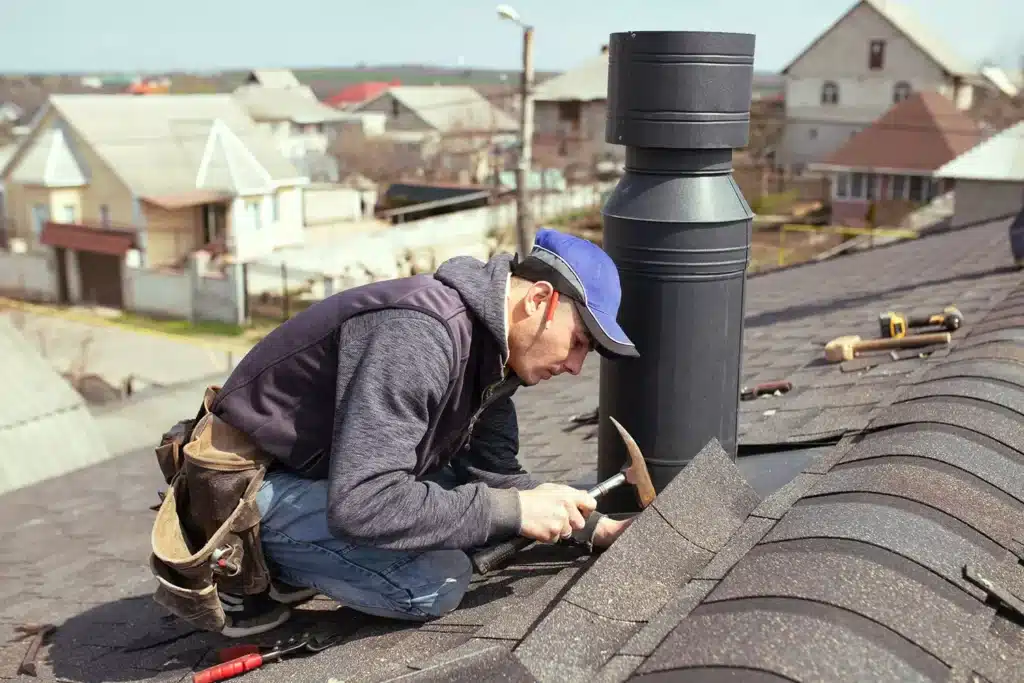
Here at Emergency Roofers Dublin, the shingling hammer is one of the most trusted tools in our arsenal. Its incredible versatility makes it our go-to for a whole range of critical services.
- Storm Damage Repairs: After one of the gales that frequently batters our coast, the hammer’s hatchet/claw combination is a lifesaver for quickly and cleanly removing damaged shingles and clearing away debris to find the source of a leak.
- New Asphalt Shingle Installations: For new roofs on bungalows and semi-detached homes across the city, that little gauge is absolutely essential. It helps us ensure every roof meets the strict building regulations for spacing and alignment.
- Chimney and Gutter Work: The handy hatchet end lets us make precise cuts on the fly, fitting shingles perfectly around obstacles to create a watertight seal where the roof meets the masonry.
- Full Re-Roofs: The dual-function design helps us strip old roofing material about 20% faster. That efficiency means real savings on labour, potentially keeping between €500 and €1000 right in the homeowner’s pocket.
Top Hammer Recommendation for Irish Weather
Investing in a quality, durable hammer forged from high-grade steel or titanium is a smart move. It’s an investment that will easily last 5-10 years, even when exposed to the harsh Irish weather. Cheaper tools will just rust and break on you. Here are three models our own team puts their trust in, day in and day out.
- Estwing E3-16S: This one’s a true classic, a real workhorse. It’s got a milled face and a handy magnetic slot, with fantastic shock reduction built right into the handle. We find the grip performs exceptionally well, even in wet conditions.
- Vaughan RFH18: We love this one for its perfect balance. It’s a great all-rounder that includes a gauge, a claw hatchet, and a really comfortable rubber grip. It feels especially secure when you’re working up on a ladder.
- Stiletto TB15MC: Okay, for the professional who demands the absolute best, this is the one. It’s a premium titanium model that feels incredibly light at just 450g, but it drives nails with the force of a much heavier steel hammer. Its shock absorption is second to none, making it perfect for reducing fatigue on those long, all-day jobs.
Frequently Asked Questions About Shingling Hammers
Think of a shingling hammer as the roofer's multi-tool, designed specifically for installing and removing roofing shingles. Its main job is to drive nails into materials like asphalt or fiberglass shingles, but its usefulness goes much deeper. The tool has a hatchet or blade on the back of the head, which allows us to trim shingles to the perfect size without having to switch tools.
It also includes a handy gauge to measure the shingle exposure accurately. According to the experts at Empire Roof, using this specific tool streamlines the whole installation process, making sure the roofing is not only secure but also fitted perfectly for proper water runoff.
The key difference really comes down to specialisation versus general use. A regular claw hammer is a jack-of-all-trades tool for general carpentry, with a curved claw designed for pulling out nails. A shingling hammer, on the other hand, is a specialist's instrument.
It includes a built-in gauge for measuring shingle overlap and a hatchet blade for cutting roofing materials, features a standard hammer simply doesn't have. Jersey Strong Roofing also highlights that shingling hammers often have a magnetized head to hold a nail for a one-handed start, a critical safety feature for anyone working on a slope that you won't find on a standard claw hammer.
Technically, yes, you can, but we really wouldn't recommend it. It's an inefficient approach that opens the door to costly installation errors. A standard hammer is missing the adjustable gauge you need to set the correct shingle exposure (usually 5-6 inches here in Ireland).
Without that guide, you have to measure every row by hand, which slows down the job and often leads to uneven lines. On top of that, as Shumaker Roofing notes, standard hammers are often heavier and lack the specific shock-absorbing grips found on roofing tools, which means you'll get tired faster and have a higher risk of repetitive strain injuries after the thousands of strikes a roof requires
That little gauge is a roofer's best friend for ensuring consistency. It’s a small, often adjustable metal tab on the hammer’s head that we use to measure shingle exposure. You just hook it onto the edge of the shingle you just laid, and it shows you exactly where the next row should begin.
This guarantees not just a uniform appearance, but more importantly, consistent and reliable weatherproofing. Proper exposure is what stops wind from lifting your shingles and prevents water from getting underneath. Metal Roofing Solution explains that using this built-in gauge dramatically reduces spacing errors, ensuring the roof meets warranty standards and local building codes for overlap.
The hatchet, or blade end, is a fantastic two-in-one feature for cutting and splitting. We use it to trim asphalt shingles on the spot, so they fit snugly around things like chimneys, vents, and roof valleys. It lets us make immediate adjustments without ever reaching for a utility knife.
We also use it to split wood shakes or to carefully lift old, damaged shingles during a repair job. IKO Roofing points out that this integrated cutting tool reduces the number of tools a roofer has to carry, which speeds up the workflow by combining cutting and nailing into one fluid motion.
The magnet is a simple but brilliant feature designed for both safety and speed. You'll find it on the striking face or in a dedicated slot on the head. It holds the roofing nail securely in place, allowing a roofer to start the nail with just one hand.
This is incredibly important when working on steep pitches or in tricky weather, as it means we can keep one hand firmly on the ladder or roof for balance. Seasons Cleaning Services adds that this feature also means fewer dropped nails and a faster nailing process, since you don't have to awkwardly hold each nail in place with your fingers before striking.
Finding the right weight is a bit like Goldilocks, not too heavy, not too light. The sweet spot for a shingling hammer usually falls between 400g and 600g (that's about 14 to 22 ounces). A lighter hammer, like a 450g titanium model, allows for a faster swing and causes much less arm fatigue over a long day.
Heavier hammers might drive nails in with fewer strikes, but they can cause significant strain over time. iRoofing suggests that for common asphalt shingles, a lighter weight is better to avoid damaging the material, while slightly heavier options might be useful for tougher materials or demolition work.
For the kind of weather we get here in Ireland, a milled (or "waffled") face is almost always the smarter choice. The textured surface provides a much better grip on the nail head, preventing the hammer from sliding off if the nail or the hammer face gets wet, which, let's be honest, is a common occurrence in Dublin.
This means fewer bent nails and less accidental damage to the shingle's surface. While Metal Roofing Solution does note that a smooth face is a bit gentler on the shingle if you happen to miss the nail, the grip advantage of a milled face in our damp climate makes it the professional standard for any outdoor roofing work.
You can expect to invest a little in a quality tool. A top-notch steel shingling hammer from a trusted brand like Estwing or Vaughan typically costs between €40 and €60. If you want to go for a premium model made from titanium, like those from Stiletto, you could be looking at €70 to €80 or more.
While cheaper options are out there, they often lack the proper balance, durability, and safety features. Investing in a professional-grade tool is an investment in quality work. Based on Emergency Roofers Dublin's market analysis, a mid-range €50 hammer offers the best balance of performance and value for most homeowners and tradespeople.
This is a great question, and the answer is, it depends on the job. For repairs, smaller projects, and any kind of detailed work, a shingling hammer wins hands down. It gives you incredible precision, requires zero setup time, and costs significantly less.
Nail guns are certainly faster for laying down long, open stretches of a new roof, but they are heavy, require maintenance, and can easily overdrive nails, which damages the shingle. IKO Roofing highlights that a hammer lets a roofer "feel" the roof deck, ensuring each nail bites into solid wood, whereas a gun might blindly fire into a rotten spot or a gap without the operator ever noticing.
Its safety benefits are huge, mainly thanks to the magnetic nail holder and its all-in-one design. By enabling one-handed nailing, it allows a roofer to maintain three points of contact with the roof or ladder more often, which is a fundamental rule of safety.
The integrated blade also means fewer trips up and down the ladder to grab cutting tools. Furthermore, the ergonomic grip helps prevent grip failure caused by hand fatigue. As Jersey Strong Roofing emphasizes, keeping a roofer balanced and reducing their physical strain are two of the most important factors in preventing falls and accidents on site.
If you want a tool that won't let you down, the most trusted brands you'll find among Dublin's professionals are Estwing, Vaughan, and Stiletto. Estwing is famous for its rock-solid steel construction and incredible durability. Vaughan offers excellent wooden-handled options with great vibration dampening. Stiletto is the clear leader in lightweight titanium hammers that pack a serious punch.
Reviews from iRoofing and local suppliers consistently name the Estwing E3-16S and the Stiletto TB15MC as top performers because of their build quality, perfect balance, and suitability for the wet, windy conditions we so often face on Irish roofs.
If your roof demands professional attention, do not leave it to chance. Contact Emergency Roofers Dublin today for expert service that combines the right tools with decades of local experience.